
We Could Be Taking More Risks
On Kim Gordon, Nirvanna The Band, and Embracing Impossibility
I’ve started to feel like I’ve entered a religious cult. Like a zealous convert, I feel like I need to spread the good news. I’m constantly battling every instinct I have not to mention Nirvanna the Band the Show: The Movie in every conversation.
About a month ago, I would’ve struggled to articulate to you what Nirvanna the Band the Show even is. Now it’s all I can think about. And the deeper I dig into it, the more obsessed and inspired I become.
I had only the loosest idea of what Nirvanna the Band the Show was. I’d heard that it was a web series and then a real show, and it revolved loosely around a group calling themselves Nirvanna the Band. The idea of movie tie-ins to shows always puts me off, even for series I do like. Yet I saw some buzz on corners of the internet and fans alleging you don’t need to watch the show beforehand. I took a gamble and ended up going on opening night.
I’ve hardly ever felt so understood while also not totally understanding what I was seeing. It’s hard to talk about this movie. Even as I’ve tried to sell it to friends, I’ve been overly cautious not to spoil any of the jokes and plot points. But here’s the gist of the series as a whole: Toronto locals Matt Johnson and Jay McCarrol are in a band called Nirvanna the Band and desperately want to get a show at a venue called The Rivoli in Toronto, and are always conducting some harebrained scheme to get booked that never works out. It’s Pinky and the Brain meets a more wholesome Nathan for You.
Trying to explain the comedy of it all isn’t going to be fun. But what’s really grabbed me about the movie is how it was made. Much of the movie is filmed in public. So there are insane scenes and stunts that they just filmed around Toronto, no permits and often without a plan. There’s a Jackass quality to it in that way. You’re getting real, honest reactions—people just walking down the street suddenly become breakout stars.
I’ll give one example. There are a few scenes filmed outside Drake’s mansion (yes, that Drake). During the height of his beef with Kendrick Lamar in 2024, there was a shooting at his house. Matt and Jay sensed an opportunity and rushed over with their crew. They filmed some scenes that (again, without giving anything away) become pivotal to the film’s plot. Again, there was no plan. But they knew a good idea when they saw it. They passed themselves off as press and got away with it. If you look at news footage from that day, you can actually spot them roaming around.
“Because it’s illegal, that means nobody’s done it,” Matt Johnson mentions in this video with TIFF from 2018. To be fair, I think there are a lot of things that are illegal that people certainly have done, but I get what he means (in this context, he’s talking about a scene in their show where they film in Toronto’s subway tunnels). For Nirvanna the Band the Show, the rules are important because they show the creators where they can step outside from.
So many moments in the movie and the show leave you with two complementing feelings: “How was it even possible?” and “I think I could do that.” That, to me, is endlessly inspiring.
I think I know why I’ve gotten obsessed with this movie and broader project. More and more, I feel the world becoming static. From the sameness of the doom scroll, to the font choices at the grocery store, to the way we talk to each other in “professional settings” with vapid buzzwords and phrases… it’s all becoming the same. Seeing people create outside the rules and guidelines feels refreshing.
Two words never fail to make my heart sink: best practices. What’s worse is knowing that I’ve used them many times. Part of living in the modern world (and keeping a job) is knowing how to speak the language. Best practices is just a way of saying “follow the rules.”
I want to tell you I’ve always been eager to break the rules, but that’s not true. As a kid, I was afraid to do anything bad. I wanted to be good and not cause any problems for others. I wasn’t perfect and, of course, I messed up a lot, but I thought following the rules would lead to success and keep everyone safe. That’s what they’re there for, right?
Of course, there are times when rules make sense. They’re meant to guide us—to take the wisdom of the past and let us skip some obvious mistakes. But there’s a point where guidance becomes doctrine; when the rules go unchallenged long enough, we forget to question if they even make sense. There’s a lot there to spiral off into, but what I’m fixated on right now is what the rules mean for creativity. The idea of best practices feels like a way of keeping everything the same—a strict regimen to keep things neat, tidy, and successful. They’re also very boring. And they keep us from seeing a whole world of other creative opportunities.
I kept thinking about all this again as I fell back in love with another innovator, the incomparable Kim Gordon. There may be no one cooler, no better embodiment of eschewing the norms than Gordon. From the first time I heard Sonic Youth classic tracks like “Teenage Riot” and “Kool Thing,” I was enamored by her voice—detached and untouchable, above it all with art-rock wisdom I couldn’t fathom if I tried. But a lot of people “were cool once.” Gordon has maintained this level of innovativeness across decades, eras, and regime changes.
For the last couple of weeks, I’ve been obsessively listening to her latest album, PLAY ME. At 72 years old, she’s making some of the most current and forward-thinking music I’ve heard in years. I wasn’t totally surprised to hear trap beats, as she’s toyed with them on past albums like 2019’s excellent No Home Record and even parts of her noisier 2024 album The Collective. But here they’re not a texture—they’re the canvas she builds off of.
Her cadence has always felt close to rapping, but here she is really leaning into it, dropping lines about “make out jams” and “chill vibes” with confidence and ease that would bewilder artists fifty years her juniors. But it doesn’t feel like she’s in competition with anyone. She feels like she’s searching. She brings a lifetime of punk aesthetics and ethics to the music. Songs like “NOT TODAY” and “GIRL WITH A LOOK” bring in dreamy indie-rock instrumentation but don’t feel out of place. Her lyrics are completely free from pretense or expectation. The way she spits out buzzy phrases on closer “BYEBYE25!” feels insane. I had to do a double take on first listen—did she just say “measles, peanut allergy, abortion?”
None of this is what I would expect an artist in their seventies to be doing. Collective bias might have us thinking at this stage artists are expected to get a bit more “reflective,” like this is the time to look back. Yet Gordon only knows how to look forward. She made a life out of pushing boundaries. Why stop at this point?
Gordon and Nirvanna the Band both make me think about jazz renegade Sun Ra. Ra was on a constant quest to confront and embody impossibility. Particularly in this story, when Ra told vocalist Art Jenkins he didn’t want a nice voice in his band, he wanted something “impossible.”
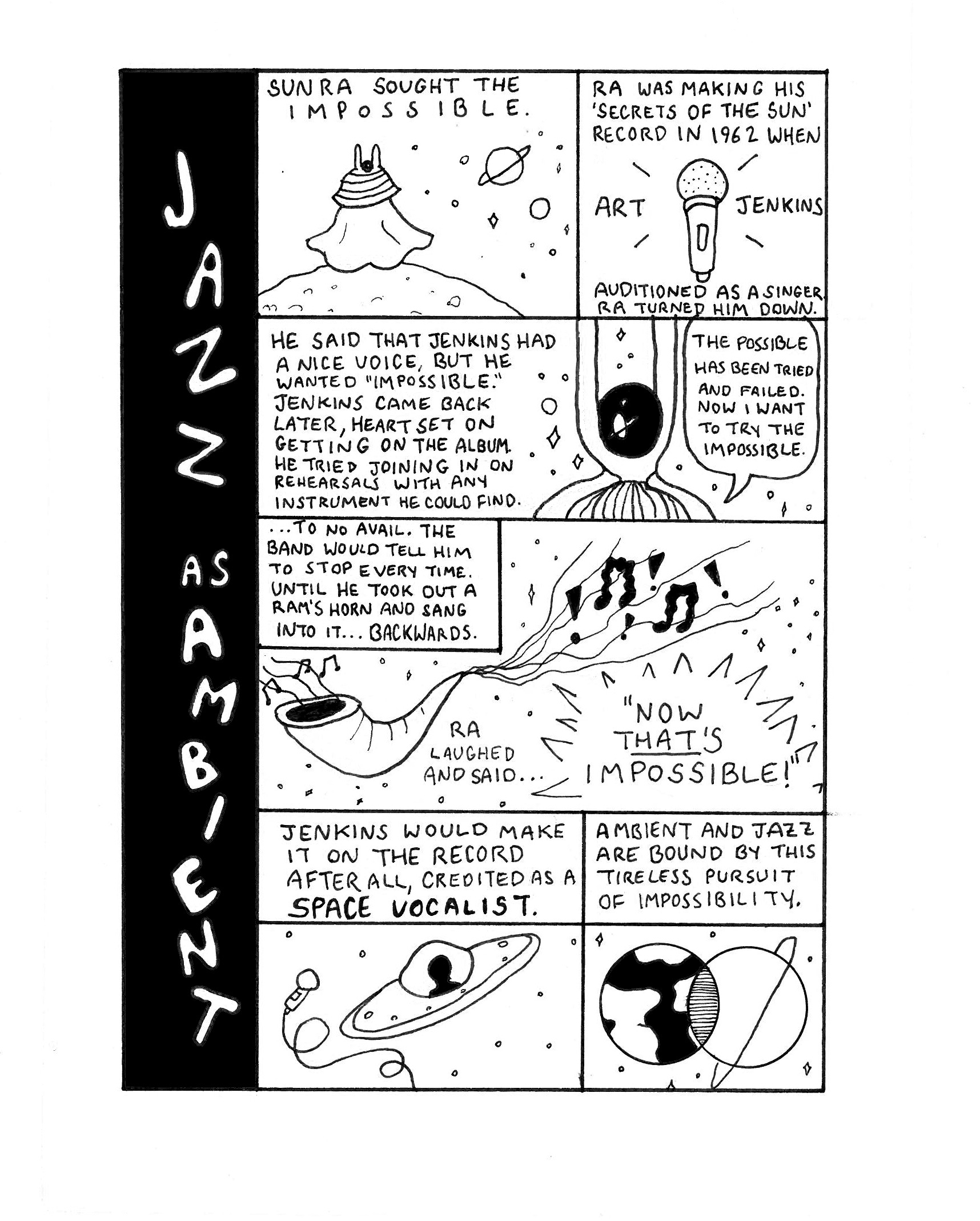
I love this idea of impossibility. By definition, it’s unachievable. But artists like those I’ve mentioned don’t see impossibility as definitive—it’s a challenge. The rules give us the structure, which helps us know what we need to break out of.
When I say “we could be taking more risks,” I’m talking to myself first and loudest. But it is also meant for all of us.
I’m not trying to be some LinkedIn “inspirational post” about “breaking the mold” here either. But looking at Nirvanna the Band the Show, Kim Gordon, and Sun Ra, I feel an overwhelming sense of needing to look at what I’m doing and how I can think about it differently. We have so many tools at our disposal—the technology in our pockets is more advanced than what we used to go to the moon. Why use that to make a graphic or clip that specifically adheres to best practices and style guidelines to “maximize engagement”? We should be using this stuff to…do something fucking cool.
Modern life feels like it wants to grind us down to complacency. But it doesn’t have to be that way. I find a lot of value in looking at how things are done, learning the rules, and mastering skills. There’s this idea put forth by Brian Eno of being a “farmer or a cowboy”—the farmer who focuses on cultivating their one corner of land and the cowboy who seeks new horizons. In one of the first editions of Another Thought, I argued in defense of the farmer. But even if you’re perfecting and focusing on a certain lane, I think that’s even more cause for innovation. When you know something well, you’re well equipped to push it to its brink and think about it in new ways.
Thinking about artists like these makes me want to push my own limits on storytelling. It’s been exhausting having to constantly learn new skills over the years to try and keep up with the times (and stay employed) when all I ever really wanted to do was write. Now I’m thinking of Matt and Jay taking their camera onto the street and just seeing what happens. Kim Gordon throwing on a trap beat and putting a mirror to the world around her. Art Jenkins singing backwards into a horn. Artists who take the tools they have and push new ideas forward.
It makes me want to take more risks. To stop thinking about the “right way” or what’s possible, and start following ideas that don’t fully make sense yet.
I’m tired of the sameness. I bet you are too. We’ve seen others prove this doesn’t have to be the way. The impossible is within reach. Time to leap toward it.
Want to Support Another Thought? Okay, I’m Down!
I appreciate you reading Another Thought, whether this is your first post or you’re a long-time reader. Another Thought is a labor of love fueled by very long deadline nights, lots of art supplies, and espresso at ungodly hours.
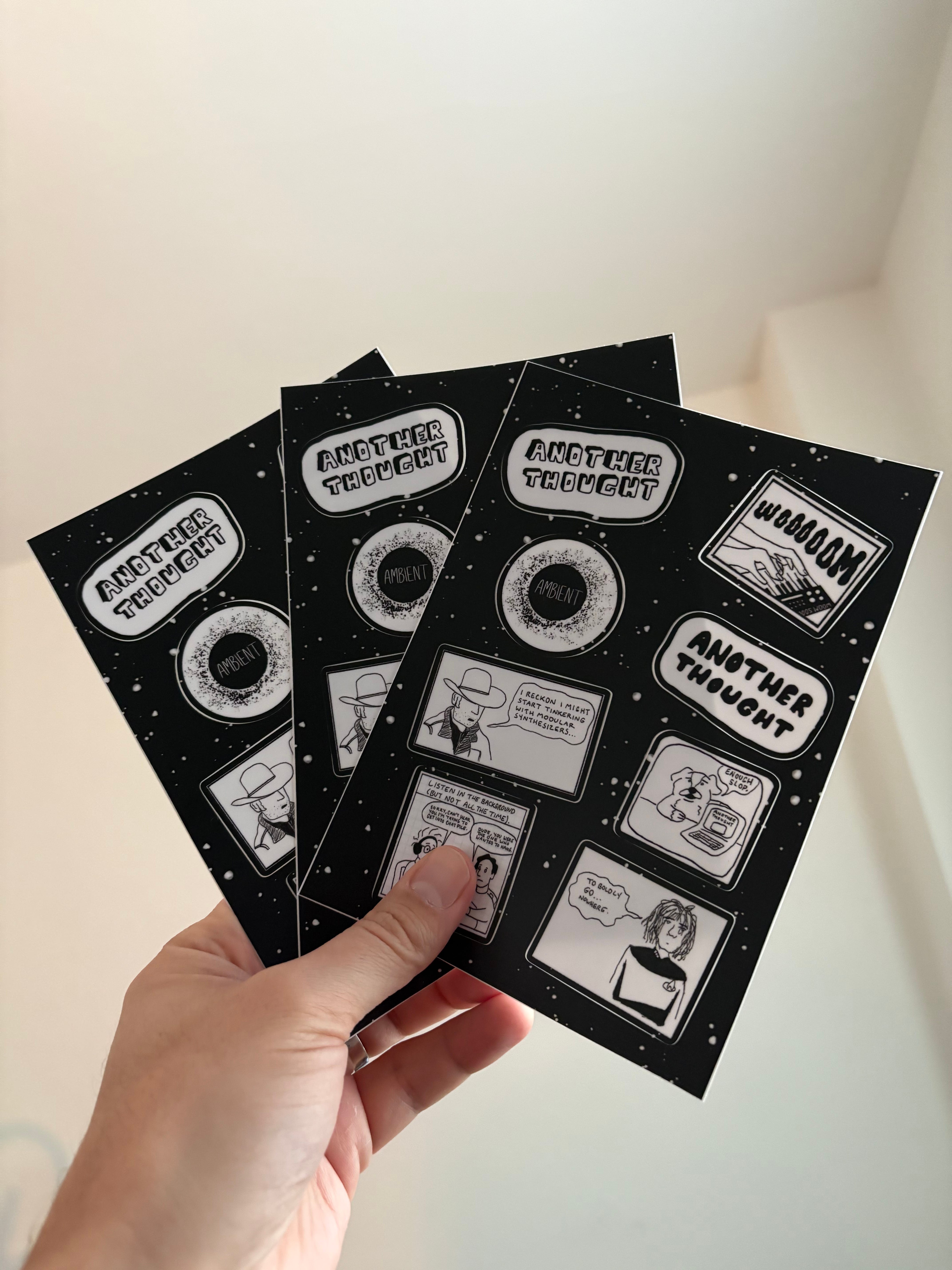
If you want to support the newsletter, please consider becoming a paid subscriber at $5/mo. You’ll get exclusive newsletters, early access to upcoming physical media, and a sheet of stickers featuring drawings from the newsletter and my book mailed to you!
My Book 20th Century Ambient is Out Now!

Through text and comics, 20th Century Ambient traces the recent history of ambient music to uncover how the genre has evolved and the role it plays in our daily lives. If you dig the combination of art and essays on Another Thought, I think you’ll love this book.
“Enriched by vivid profiles of the genre’s practitioners and capped by a list of essential tracks, it’s a quirky love letter to an enigmatic sound.” - Publishers Weekly
“Dad! Your book isn’t boring! It has pictures in it! It’s hilarious. Kids can read it too!” - my child
20th Century Ambient is out now from Bloomsbury Books.
I love getting on here to chime in about things! I think it's because I feel less reticent to participate in a comment thread because, you know, we're actually friends lol.
1. Hahaha the first thing I thought about when reading about Nirvanna the Band the Show: The Movie was when you told me you had saw it. "What is it actually about??" "Uhhh, I don't really know?"
2. You're a Capricorn, so I know you LOVE rules lol. But I also like the idea of you coming up with a set of rules that fly in the face of The Rules in order to be more creative.
3. One of the few things I enjoy about not being colleagues is that although we still chat pretty much daily, I never have to hear anyone we worked for use the term "best practices" ever again.
4. The part of Kim's album that gets stuck in my head the most is when the beat cuts out of "BYEBYE25!" and it's just Kim saying, "TRANSGENDER." I don't know why that has left such an impression on me or why I think it's so cool, but I fucking love it.
You sold me, going to check out the film. All I hear is great things